Week 01 · lesson
Investigation: Where System Behavior Comes From
Two systems can accept similar inputs and produce similar-looking outputs while working in completely different ways. In this guided investigation, you will trace three mechanisms before the Lab asks you to compare complete systems.
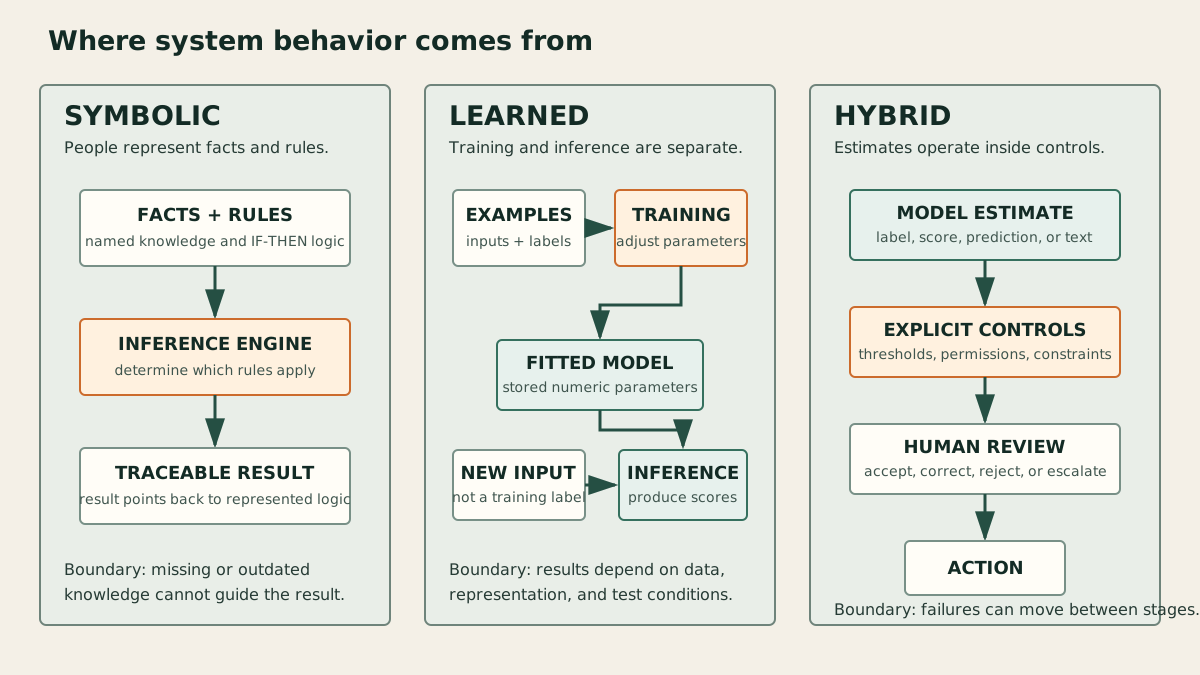
Diagrams open at a readable shape-aware scale. Zoom or expand when you need more detail.
Explicit rules: behavior written as logic
A symbolic system represents knowledge using facts, symbols, and rules. An inference engine determines which rules apply.
FACT: temperature = 31°C
FACT: humidity = 74%
RULE: IF temperature > 28°C THEN fan = on
RULE: IF humidity > 70% THEN vent = open
RESULT: fan on, vent open
The result is traceable. You can point to the facts and rules. That does not make the system complete. If humidity is missing, the second rule cannot be evaluated. If the rule is outdated, the system can produce a traceable mistake.
Learned parameters: behavior fitted from examples
A learned system separates training from inference. During training, examples and an objective adjust numeric parameters. During inference, the fitted model uses those stored parameters on a new input.
TRAINING: labeled images → adjust parameters → fitted model
INFERENCE: new image → fitted model → label and score
You normally cannot explain one output by pointing to a single written rule. You test the model with labeled cases and changed conditions. The partly hidden bottle matters because it checks whether the learned patterns still work when some visual evidence disappears.
Search: compare possible actions
A route planner can represent a map, generate possible moves, reject illegal ones, and continue until it reaches the goal. Its intelligence is not a stored sentence that says “turn left.” It is the search procedure operating on a represented problem.
Search can still fail when the representation is wrong. A perfect search over a stale map produces a route for the wrong world. The computer is not confused. It is solving the problem it received.
Hybrid systems combine mechanisms
Real systems often combine learned estimates with explicit controls. A learned camera model might estimate an object label, a written rule might require a minimum score, and a person might review uncertain cases. Calling the whole pipeline “the model” erases the parts that can fail separately.
| Mechanism | Behavior comes from | Strong inspection method | Common boundary |
|---|---|---|---|
| Explicit rules | represented facts and written logic | trace fired rules | missing or outdated knowledge |
| Learned parameters | examples, objective, and training process | test labeled and shifted cases | unfamiliar patterns or biased examples |
| Search | states, actions, constraints, and search strategy | replay path and constraints | incomplete state or map |
Guided investigation: do not change the rule yet
The greenhouse system outputs insufficient input instead of vent open.
- First guess: The humidity rule is broken.
- Trace: Temperature is
31°C; humidity ismissing. - Diagnosis: The rule requires a humidity fact. It cannot compare a
missing value with
70%. - Correction: Restore or verify the sensor reading before rewriting the rule.
- Boundary: One repaired reading does not prove the sensor is reliable.
This is the habit you will use in the Lab: identify the mechanism, inspect its required representation, and change one condition before explaining the failure.
Vocabulary lab
Flip the idea, not just the card
Explain the term before you reveal the back. Then compare your explanation with the definition, example, and warning.
Read all terms without animation
- symbolic system
- An AI approach that represents knowledge with facts, symbols, relationships, and explicit rules. Example: Greenhouse facts trigger declared fan and vent rules. Do not confuse it with: Symbolic does not mean imaginary; it means knowledge is explicitly represented.
- inference engine
- The part of a symbolic system that determines which rules apply to available facts. Example: It checks whether temperature is above 28 degrees. Do not confuse it with: Inference here is rule application, not learned-model inference.
- training
- The process that adjusts model parameters from examples and an objective. Example: Labeled images adjust a bottle classifier before it is used. Do not confuse it with: Training is separate from running the fitted model on one new image.
- learned parameters
- Numeric values fitted during training that shape a model's output. Example: Stored parameters turn new pixel patterns into bottle scores. Do not confuse it with: They are not the same as written IF-THEN rules.
- search
- A mechanism that compares possible states or actions to find a path toward a goal. Example: The planner explores legal grid moves around obstacles. Do not confuse it with: Search does not require predicting a person's future choice.