Unit 01 · lesson
Defining Data Science
 |
|---|
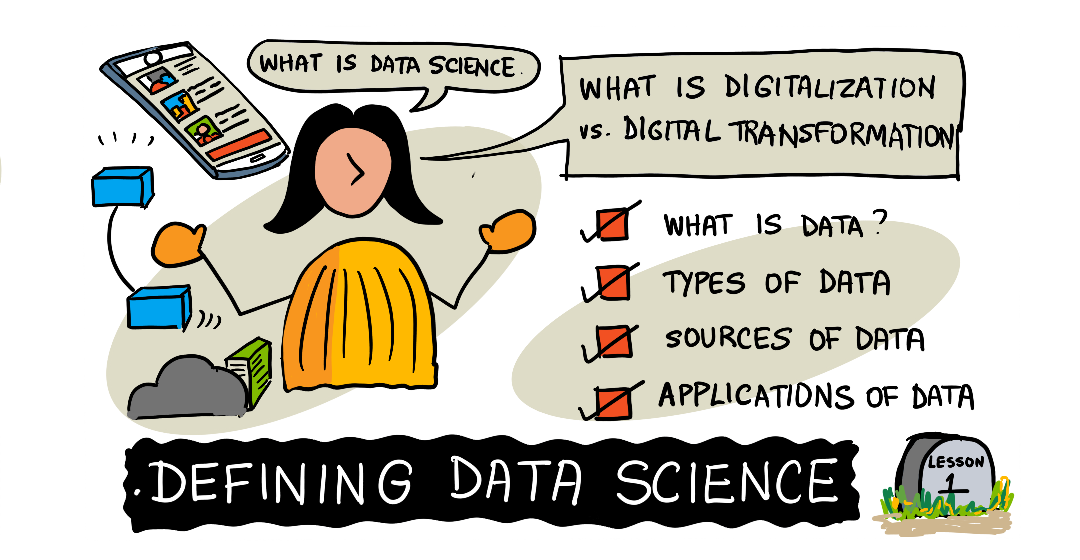
| Defining Data Science - Sketchnote by @nitya |
Pre-lecture quiz
What is Data?
In our everyday life, we are constantly surrounded by data. The text you are reading now is data. The list of phone numbers of your friends in your smartphone is data, as well as the current time displayed on your watch. As human beings, we naturally operate with data by counting the money we have or by writing letters to our friends.
However, data became much more critical with the creation of computers. The primary role of computers is to perform computations, but they need data to operate on. Thus, we need to understand how computers store and process data.
With the emergence of the Internet, the role of computers as data handling devices increased. If you think about it, we now use computers more and more for data processing and communication, rather than actual computations. When we write an e-mail to a friend or search for some information on the Internet - we are essentially creating, storing, transmitting, and manipulating data.
Can you remember the last time you have used computers to actually compute something?
What is Data Science?
In Wikipedia, Data Science is defined as a scientific field that uses scientific methods to extract knowledge and insights from structured and unstructured data, and apply knowledge and actionable insights from data across a broad range of application domains.
This definition highlights the following important aspects of data science:
- The main goal of data science is to extract knowledge from data, in other words - to understand data, find some hidden relationships and build a model.
- Data science uses scientific methods, such as probability and statistics. In fact, when the term data science was first introduced, some people argued that data science was just a new fancy name for statistics. Nowadays it has become evident that the field is much broader.
- Obtained knowledge should be applied to produce some actionable insights, i.e. practical insights that you can apply to real business situations.
- We should be able to operate on both structured and unstructured data. We will come back to discuss different types of data later in the course.
- Application domain is an important concept, and data scientists often need at least some degree of expertise in the problem domain, for example: finance, medicine, marketing, etc.
Another important aspect of Data Science is that it studies how data can be gathered, stored and operated upon using computers. While statistics gives us mathematical foundations, data science applies mathematical concepts to actually draw insights from data.
One of the ways (attributed to Jim Gray) to look at the data science is to consider it to be a separate paradigm of science:
- Empirical, in which we rely mostly on observations and results of experiments
- Theoretical, where new concepts emerge from existing scientific knowledge
- Computational, where we discover new principles based on some computational experiments
- Data-Driven, based on discovering relationships and patterns in the data
Other Related Fields
Since data is pervasive, data science itself is also a broad field, touching many other disciplines.
Types of Data
As we have already mentioned, data is everywhere. We just need to capture it in the right way! It is useful to distinguish between structured and unstructured data. The former is typically represented in some well-structured form, often as a table or number of tables, while the latter is just a collection of files. Sometimes we can also talk about semi-structured data, that have some sort of a structure that may vary greatly.
| Structured | Semi-structured | Unstructured |
|---|---|---|
| List of people with their phone numbers | Wikipedia pages with links | Text of Encyclopedia Britannica |
| Temperature in all rooms of a building at every minute for the last 20 years | Collection of scientific papers in JSON format with authors, data of publication, and abstract | File share with corporate documents |
| Data for age and gender of all people entering the building | Internet pages | Raw video feed from surveillance camera |
Where to get Data
There are many possible sources of data, and it will be impossible to list all of them! However, let's mention some of the typical places where you can get data:
- Structured
- Internet of Things (IoT), including data from different sensors, such as temperature or pressure sensors, provides a lot of useful data. For example, if an office building is equipped with IoT sensors, we can automatically control heating and lighting in order to minimize costs.
- Surveys that we ask users to complete after a purchase, or after visiting a web site.
- Analysis of behavior can, for example, help us understand how deeply a user goes into a site, and what is the typical reason for leaving the site.
- Unstructured
- Texts can be a rich source of insights, such as an overall sentiment score, or extracting keywords and semantic meaning.
- Images or Video. A video from a surveillance camera can be used to estimate traffic on the road, and inform people about potential traffic jams.
- Web server Logs can be used to understand which pages of our site are most often visited, and for how long.
- Semi-structured
- Social Network graphs can be great sources of data about user personalities and potential effectiveness in spreading information around.
- When we have a bunch of photographs from a party, we can try to extract Group Dynamics data by building a graph of people taking pictures with each other.
By knowing different possible sources of data, you can try to think about different scenarios where data science techniques can be applied to know the situation better, and to improve business processes.
What you can do with Data
In Data Science, we focus on the following steps of data journey:
Of course, depending on the actual data, some steps might be missing (e.g., when we already have the data in the database, or when we do not need model training), or some steps might be repeated several times (such as data processing).
Digitalization and Digital Transformation
In the last decade, many businesses started to understand the importance of data when making business decisions. To apply data science principles to running a business, one first needs to collect some data, i.e. translate business processes into digital form. This is known as digitalization. Applying data science techniques to this data to guide decisions can lead to significant increases in productivity (or even business pivot), called digital transformation.
Let's consider an example. Suppose we have a data science course (like this one) which we deliver online to students, and we want to use data science to improve it. How can we do it?
We can start by asking "What can be digitized?" The simplest way would be to measure the time it takes each student to complete each module, and to measure the obtained knowledge by giving a multiple-choice test at the end of each module. By averaging time-to-complete across all students, we can find out which modules cause the most difficulties for students, and work on simplifying them.
You may argue that this approach is not ideal, because modules can be of different lengths. It is probably more fair to divide the time by the length of the module (in number of characters), and compare those values instead.
When we start analyzing results of multiple-choice tests, we can try to determine which concepts that students have difficulty understanding, and use that information to improve the content. To do that, we need to design tests in such a way that each question maps to a certain concept or chunk of knowledge.
If we want to get even more complicated, we can plot the time taken for each module against the age category of students. We might find out that for some age categories it takes an inappropriately long time to complete the module, or that students drop out before completing it. This can help us provide age recommendations for the module, and minimize people's dissatisfaction from wrong expectations.
🚀 Challenge
In this challenge, we will try to find concepts relevant to the field of Data Science by looking at texts. We will take a Wikipedia article on Data Science, download and process the text, and then build a word cloud like this one:
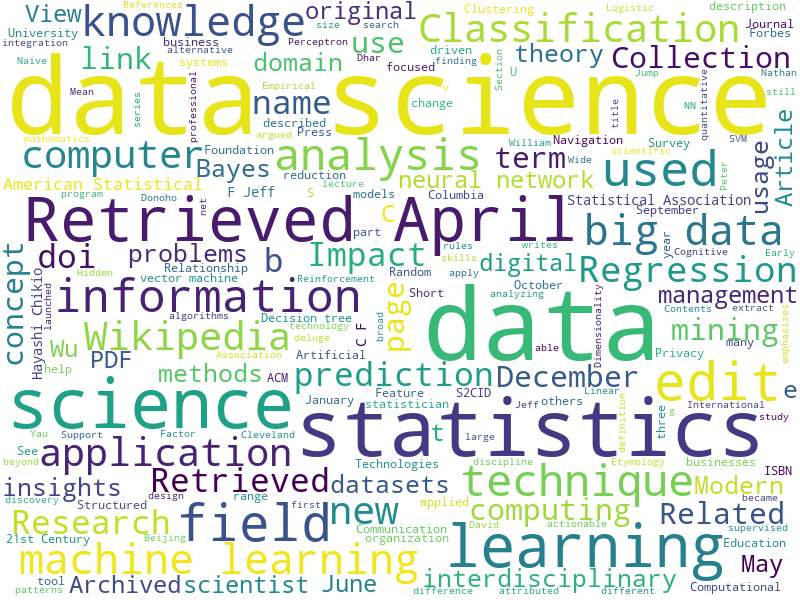
Visit notebook.ipynb to read through the code. You can also run the code, and see how it performs all data transformations in real time.
If you do not know how to run code in a Jupyter Notebook, have a look at this article.
Post-lecture quiz
Assignments
- Task 1: Modify the code above to find out related concepts for the fields of Big Data and Machine Learning
- Task 2: Think About Data Science Scenarios
Credits
This lesson has been authored with ♥️ by Dmitry Soshnikov