Week 07 · lesson
Lesson 1: Network Hardware and Internet Edge Devices
Core path: 42 minutes
A consumer box may combine routing, switching, Wi-Fi, firewall, and modem functions. A technician still needs to separate those jobs.
Core devices
- NIC connects an endpoint to network media and has a physical MAC address used at the local-link layer.
- Switch connects devices within a LAN. A managed switch exposes configuration/monitoring features; an unmanaged switch is simpler and largely plug-and-play.
- Router moves traffic between IP networks and commonly provides the SOHO default-gateway role.
- Access point bridges wireless clients into the local network.
- Patch panel terminates/organizes structured cabling. It is not a switch.
- Firewall applies traffic-control policy.
PoE
Power over Ethernet can deliver data and power over compatible Ethernet cabling. Power may come from a PoE-capable switch or injector.
At recognition depth, know the common IEEE families:
802.3af— PoE;802.3at— PoE+;802.3bt— higher-power PoE variants often called PoE++.
Do not select only by marketing name. The endpoint's required power class, the switch/injector capability, and the cable/install path must be compatible.
Internet edge devices
- Cable modem connects to a cable-provider service.
- DSL modem/gateway uses supported telephone-line infrastructure.
- ONT terminates an optical fiber service and presents customer-facing connectivity.
Do not call every provider box a modem when the physical service is different.
Guided case
A PoE access point has Ethernet link but never powers on. The switch port is not PoE-capable and no injector is present.
That is a power-delivery mismatch, not evidence that the AP's Wi-Fi radio is defective.
Student action
Build a device-role map containing router, managed switch, unmanaged switch, AP, patch panel, firewall, PoE injector/switch, cable modem, DSL device, ONT, and NIC.
For each record:
primary job:
what it connects:
layer/boundary clue:
one thing it does NOT automatically do:
Evidence checkpoint
You should be able to look at a SOHO/network diagram and explain which device owns local switching, routing, wireless access, provider handoff, power delivery, and policy.
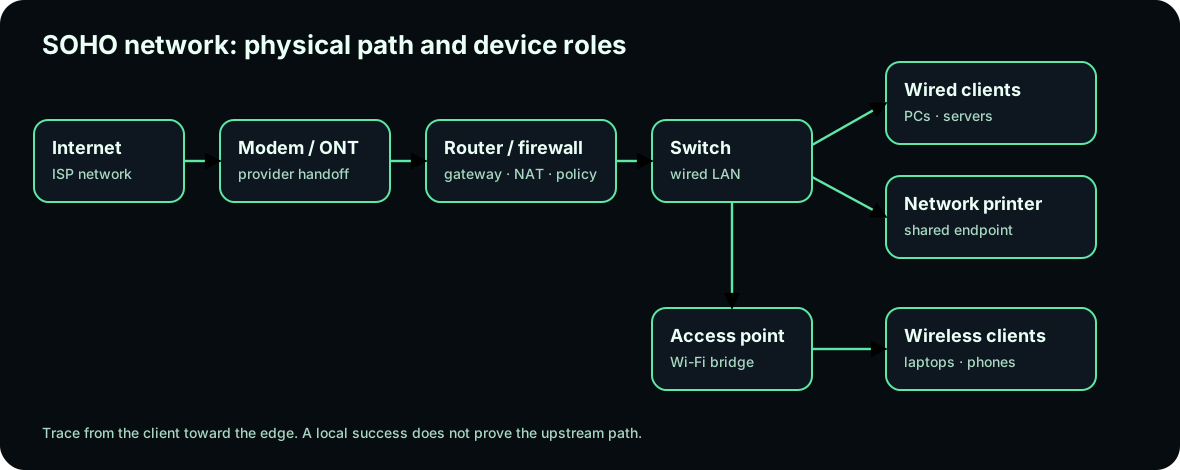
Diagrams open at a readable shape-aware scale. Zoom or expand when you need more detail.
Read it. Prove it.
Lesson knowledge checks
Answer from the lesson you just completed. Results stay in this browser and are not submitted.What is the primary difference between a switch and a router in a basic network?
What does an ONT do on a fiber internet connection?
system flow
Network Path: endpoint to remote service
Endpoint
A host creates traffic for a local or remote destination.
Local link
A switch forwards frames inside the local network.
Gateway
The router receives traffic that must leave the local network.
Routed path
Packets cross one or more networks toward the destination.
Evidence
Surviving paths and failed boundaries localize the topology fault.
Read this concept flow as plain text
- Endpoint. A host creates traffic for a local or remote destination.
- Local link. A switch forwards frames inside the local network.
- Gateway. The router receives traffic that must leave the local network.
- Routed path. Packets cross one or more networks toward the destination.
- Evidence. Surviving paths and failed boundaries localize the topology fault.